Conversion Rate Optimization (CRO): A Complete Guide to Increasing Website Conversions
Introduction
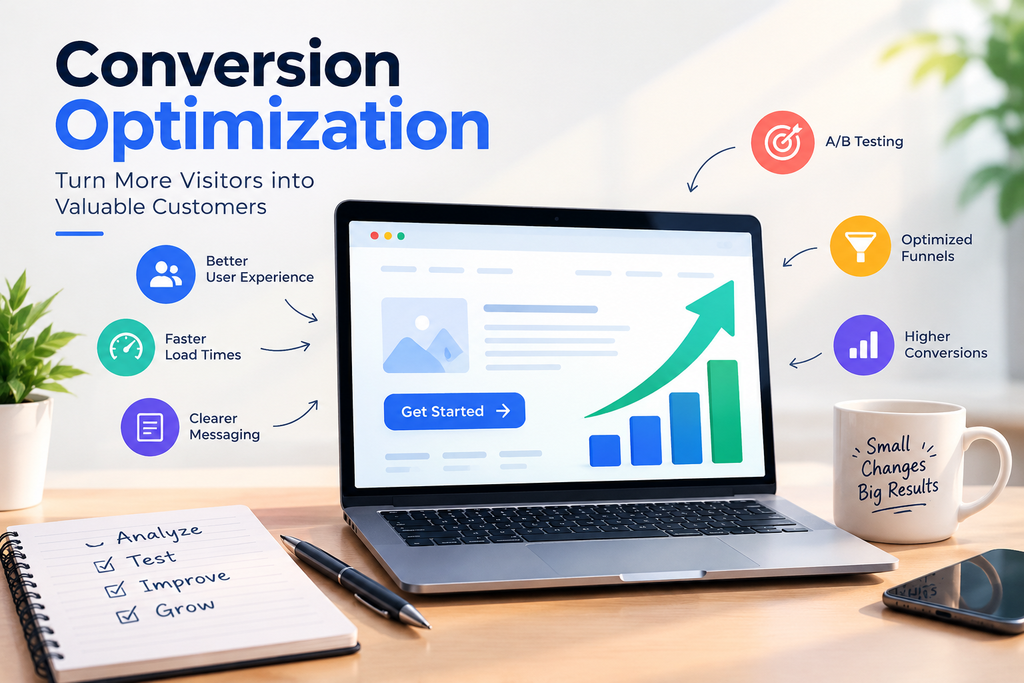
Getting traffic to your website is important, but turning that traffic into customers is what helps your business grow. Many businesses invest in SEO, social media marketing, and paid advertising to attract visitors. However, if those visitors leave without taking action, valuable opportunities may be lost.
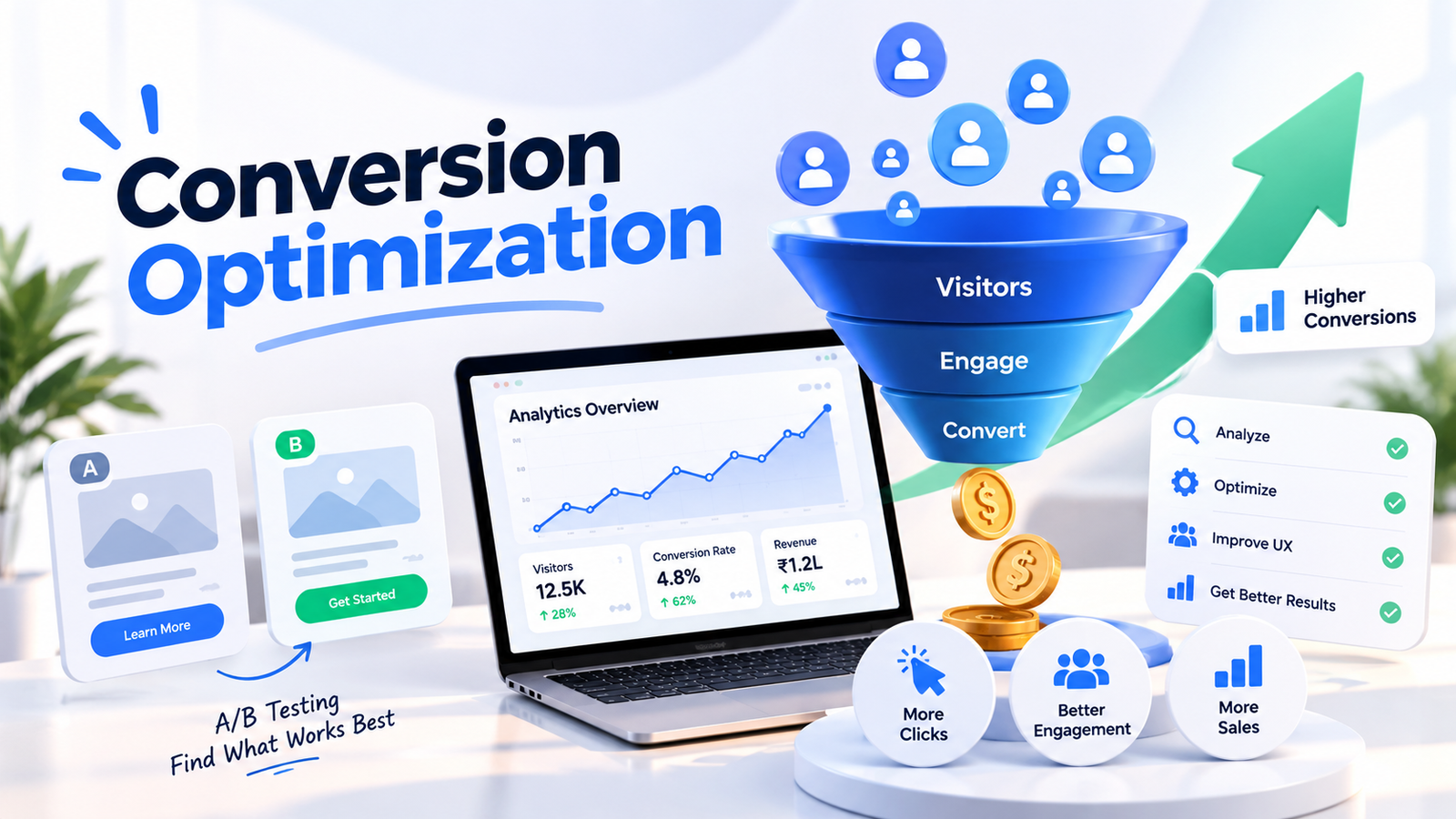
This is where Conversion Rate Optimization (CRO) becomes essential. CRO helps businesses improve their websites and landing pages to encourage visitors to take desired actions, such as making a purchase, filling out a contact form, signing up for a newsletter, or requesting a quote.
In this guide, we will explore what conversion rate optimization is, why it matters, its benefits, effective strategies, useful tools, and best practices for improving website performance.
What Is Conversion Rate Optimization (CRO)?
Conversion Rate Optimization is the process of improving a website or landing page to increase the percentage of visitors who complete a desired action.
A conversion depends on your business goals. For an e-commerce website, it might be a completed purchase. For a service-based business, it could be a consultation booking or a lead form submission.
The primary goal of CRO is to help businesses get better results from their existing website traffic without relying entirely on attracting more visitors.
How to Calculate Conversion Rate
You can calculate your conversion rate using the following formula:
Conversion Rate = (Number of Conversions ÷ Total Visitors) × 100
For example, if your website receives 5,000 visitors in a month and 150 visitors complete a purchase or another defined conversion, your conversion rate is:
(150 ÷ 5,000) × 100 = 3%
Your website’s conversion rate is 3%.
The right conversion rate varies depending on your industry, audience, offer, and conversion goal. Therefore, it is important to compare your results with your own historical performance and relevant industry benchmarks.
Why Is Conversion Rate Optimization Important?
Conversion rate optimization plays an important role in digital marketing because it focuses on making existing traffic more valuable.
Here are the main reasons why CRO matters:
1. Maximizes Website Traffic Value
CRO helps you generate more leads or sales from visitors who already reach your website. This makes your marketing efforts more productive.
2. Improves User Experience
A simple layout, clear navigation, fast loading speed, and easy-to-use forms make it easier for visitors to find information and complete actions.
3. Reduces Customer Acquisition Costs
When more visitors convert, the cost of acquiring each customer may decrease, assuming your marketing costs remain similar.
4. Increases Sales and Revenue
Optimizing product pages, checkout processes, and calls to action can help reduce friction and encourage more completed purchases.
5. Supports Data-Driven Decisions
CRO uses analytics, user feedback, and experiments to identify what works instead of relying only on assumptions.
6. Builds Customer Trust
Clear pricing, authentic reviews, transparent policies, and secure payment options help visitors feel more confident about doing business with you.
Key Benefits of Conversion Rate Optimization
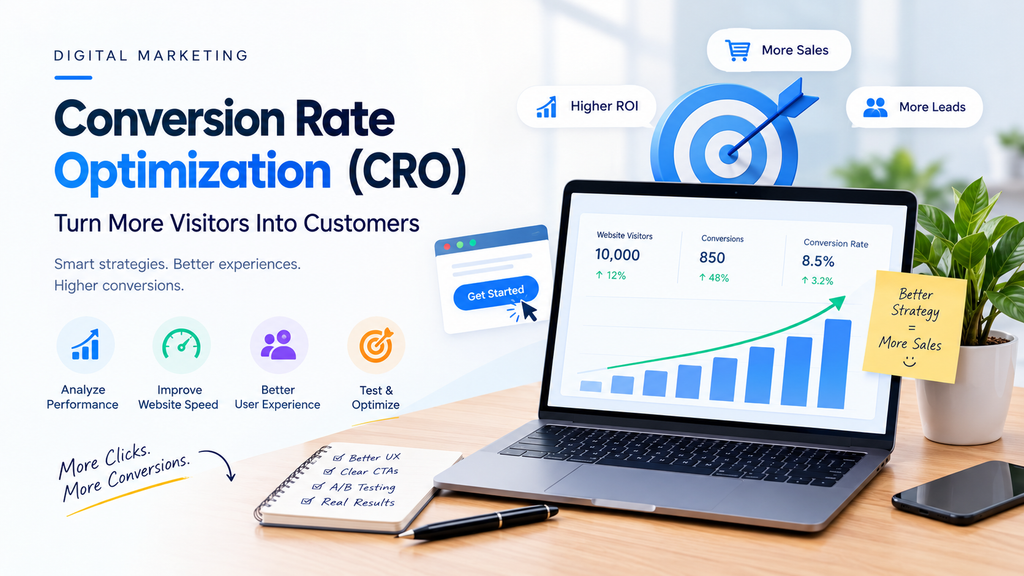
Implementing an effective CRO strategy can provide several business advantages.
- Higher conversion rates: Encourage more visitors to take meaningful actions.
- Better return on investment: Improve the results generated by SEO, paid ads, email marketing, and social media campaigns.
- Improved customer satisfaction: Make your website easier and more convenient to use.
- More qualified leads: Design landing pages and forms that attract relevant potential customers.
- Lower marketing waste: Identify pages and campaigns that fail to meet your objectives.
- Competitive advantage: Provide a smoother experience than competing websites.
- Better customer insights: Understand visitors’ needs, preferences, and concerns.
- Potential revenue growth: Increase conversions without necessarily increasing traffic.
Results depend on the quality of your website, your audience, and the changes you implement.
Best Conversion Rate Optimization Strategies
To improve website conversions, businesses should focus on the following strategies.
1. Analyze Website Performance
Start by understanding how visitors interact with your website. Identify pages with high exit rates, low engagement, weak conversion performance, or unexpected drop-offs.
Use analytics data to investigate where visitors leave and which traffic sources generate valuable actions. Remember that a high exit rate alone does not always indicate a problem; the page’s purpose and user journey matter.
2. Improve Website Loading Speed
Website speed directly affects the user experience. Slow-loading pages can frustrate visitors and interrupt the conversion process.
To improve performance:
- Compress and optimize images.
- Reduce unnecessary scripts and plugins.
- Use browser caching where appropriate.
- Choose reliable hosting.
- Optimize mobile performance.
- Monitor Core Web Vitals.
A faster website makes it easier for visitors to browse products, explore services, and complete actions.
3. Create Clear Calls to Action (CTAs)
A call to action tells visitors what to do next. Examples include “Get a Free Consultation,” “Buy Now,” “Request a Quote,” and “Download the Guide.”
Effective CTAs should be visible, specific, easy to understand, and relevant to the page’s purpose. Avoid overwhelming visitors with too many competing actions.
4. Optimize Landing Pages
Landing pages should focus on one primary conversion goal. A well-designed landing page includes a compelling headline, a clear value proposition, relevant information, trust signals, and a prominent CTA.
Ensure that the message on your landing page matches the advertisement, email, or social media post that brought visitors there.
5. Make Your Website Mobile-Friendly
Many users browse and shop on smartphones. A website that works poorly on mobile devices can lose potential customers.
Use responsive design, readable fonts, appropriately sized buttons, simple navigation, and mobile-friendly forms. Test important conversion journeys on different screen sizes and devices.
6. Simplify Forms and Checkout
Long forms and complicated checkout processes can discourage visitors from completing an action.
Ask only for the information you genuinely need. Use clear field labels, helpful error messages, and appropriate form validation. For e-commerce websites, provide transparent shipping costs, multiple suitable payment options, and guest checkout where possible.
7. Build Trust and Credibility
Visitors are more likely to convert when they trust your business.
Build credibility by including:
- Genuine customer testimonials and reviews.
- Clear contact information.
- Transparent pricing and policies.
- Relevant certifications and credentials.
- Accurate product descriptions.
- Secure payment options and appropriate privacy information.
Never use fake reviews, misleading claims, or fabricated urgency to influence customers.
8. Use A/B Testing
A/B testing compares two versions of a webpage or element to determine which performs better against a defined goal.
For example, you might compare two headlines, CTA labels, page layouts, or form designs.
To conduct a useful test, define a hypothesis, choose a primary metric, collect sufficient data, and avoid ending the test prematurely. Test one major change at a time when practical so you can interpret the results.
9. Improve Content and Messaging
Your website content should explain what you offer, who it helps, and why visitors should choose your business.
Use clear headlines, benefit-focused descriptions, concise paragraphs, relevant images, and answers to common customer questions. Remove unnecessary jargon and make the next step obvious.
10. Use Personalization Carefully
Relevant content can make a website experience more useful. Depending on your business and available data, you might display recommendations based on browsing behavior, tailor landing-page messaging to a campaign, or suggest related products.
Use personalization transparently, respect user privacy, and avoid collecting unnecessary personal information.
11. Use Heatmaps and Session Recordings
Heatmaps can show where visitors click, scroll, or focus their attention. Session recordings can help identify usability problems, confusing navigation, and form difficulties.
Use these insights to develop testable hypotheses. Apply appropriate consent, privacy protections, and data masking when collecting session recordings.
12. Optimize for Different Traffic Sources
Visitors arriving from Google search, social media, email campaigns, and paid advertising may have different needs and intentions.
Create consistent experiences between campaigns and landing pages. Analyze conversion rates by traffic source, device, campaign, and landing page to identify opportunities for improvement.
Essential CRO Metrics to Track
Tracking the right metrics helps you understand whether your optimization efforts are working.
1. Conversion Rate: The percentage of eligible visitors or sessions that complete a defined conversion.
2. Bounce or Engagement Metrics: Measures that help you understand whether visitors interact with your content. Interpret these metrics according to your analytics platform and page purpose.
3. Cost per Conversion: The marketing cost associated with generating a lead, sale, or other conversion.
4. Average Order Value (AOV): The average revenue generated per order for an e-commerce business.
5. Cart Abandonment Rate: The percentage of shopping carts that do not result in a completed purchase, based on a consistent measurement method.
6. Lead Form Completion Rate: The proportion of visitors who start or view a form and successfully submit it, depending on your chosen definition.
7. Revenue per Visitor: The average revenue generated for each measured visitor.
Track metrics that reflect your business objectives rather than optimizing for clicks or page views alone.
Best Tools for Conversion Rate Optimization
Several tools can help you analyze website behavior, identify problems, and test improvements.
- Google Analytics 4: Analyze traffic sources, user journeys, events, and conversions.
- Google Search Console: Understand search performance and identify relevant organic landing pages.
- Microsoft Clarity: Review supported heatmaps and session recordings to discover usability issues.
- VWO: Explore experimentation and website optimization capabilities, depending on your plan.
- Optimizely: Support digital experimentation and testing for eligible business needs.
- PageSpeed Insights: Evaluate page performance and receive recommendations for improvement.
Choose tools based on your website platform, budget, technical resources, privacy requirements, and testing needs.
Common Conversion Rate Optimization Mistakes to Avoid
Even well-intentioned optimization efforts can fail when businesses make these mistakes:
- Making changes without reviewing analytics or user feedback.
- Copying competitors without understanding their audience.
- Testing too many elements simultaneously without a clear testing plan.
- Ending experiments before enough data is available.
- Ignoring mobile users.
- Focusing only on increasing clicks instead of meaningful conversions.
- Making forms unnecessarily long.
- Using misleading offers or fake countdown timers.
- Ignoring website accessibility and privacy.
- Treating a single successful test as proof that the result will last forever.
A successful CRO process depends on careful analysis, testing, and continuous improvement.
Step-by-Step Conversion Rate Optimization Process
Follow this process to build a practical CRO strategy.
Step 1: Define Your Goal
Decide whether you want more purchases, qualified leads, bookings, subscriptions, or another measurable outcome.
Step 2: Collect Data
Use analytics, customer feedback, usability testing, and behavior analysis to understand current performance.
Step 3: Identify Problems
Find obstacles such as slow pages, unclear messaging, complicated forms, or unexpected drop-offs.
Step 4: Develop a Hypothesis
Explain what you want to change, why you expect it to help, and which metric should improve.
Step 5: Implement and Test
Run a controlled experiment when possible, or make a carefully measured improvement when testing is not practical.
Step 6: Measure Results
Evaluate the primary conversion metric alongside relevant guardrails, such as revenue, lead quality, or refund rates.
Step 7: Learn and Repeat
Document what you discover, implement validated improvements, and identify the next opportunity.
How CRO Supports SEO and Digital Marketing
Conversion rate optimization and search engine optimization work well together, but they serve different purposes.
SEO helps attract relevant visitors from search engines, while CRO helps those visitors complete useful actions after arriving on your website.
Combining CRO with SEO, paid advertising, content marketing, social media, and email marketing can improve the overall effectiveness of your digital marketing strategy.
For example, an SEO campaign might increase organic traffic to a service page. CRO can then help improve the page’s headline, content structure, CTA, and contact form to encourage more visitors to request a consultation.
CRO does not automatically improve search rankings, but it can help your business gain more value from its organic traffic.
Conclusion
Conversion Rate Optimization is an important part of a successful digital marketing strategy. It helps businesses understand visitor behavior, remove barriers, improve website usability, and encourage more people to take meaningful actions.
By focusing on website speed, mobile usability, clear calls to action, trustworthy content, simplified forms, analytics, and structured testing, businesses can make informed improvements to their websites.
Remember that CRO is an ongoing process rather than a one-time task. Monitor performance, listen to your customers, test your ideas, and continue improving the user experience.
Want to get more leads and sales from your website? Focus on understanding your visitors and building a website experience that makes taking the next step simple and valuable.
Frequently Asked Questions (FAQs)
1. What is conversion rate optimization in digital marketing?
Conversion rate optimization is the process of improving a website or landing page to increase the percentage of visitors who complete a desired action, such as making a purchase or submitting a lead form.
2. What is a good conversion rate?
There is no universal ideal conversion rate. It depends on your industry, traffic source, offer, audience, and conversion goal. Compare performance with relevant benchmarks and your own historical data.
3. Why is CRO important for a website?
CRO helps businesses make better use of existing traffic, improve user experience, generate more leads, and potentially increase sales without relying solely on additional advertising or visitors.
4. Which tools are used for conversion rate optimization?
Popular options include Google Analytics 4, Microsoft Clarity, VWO, Optimizely, and PageSpeed Insights. Each tool supports different aspects of analysis, experimentation, or performance improvement.
5. How long does conversion rate optimization take?
The timeline depends on website traffic, the complexity of the changes, and the conversion goal. Some usability improvements can be implemented quickly, while reliable experiments may require weeks or longer to collect enough data.
6. Is CRO useful for small businesses?
Yes. Small businesses can benefit from improving landing pages, simplifying contact forms, clarifying service information, improving mobile usability, and measuring leads or sales more effectively.