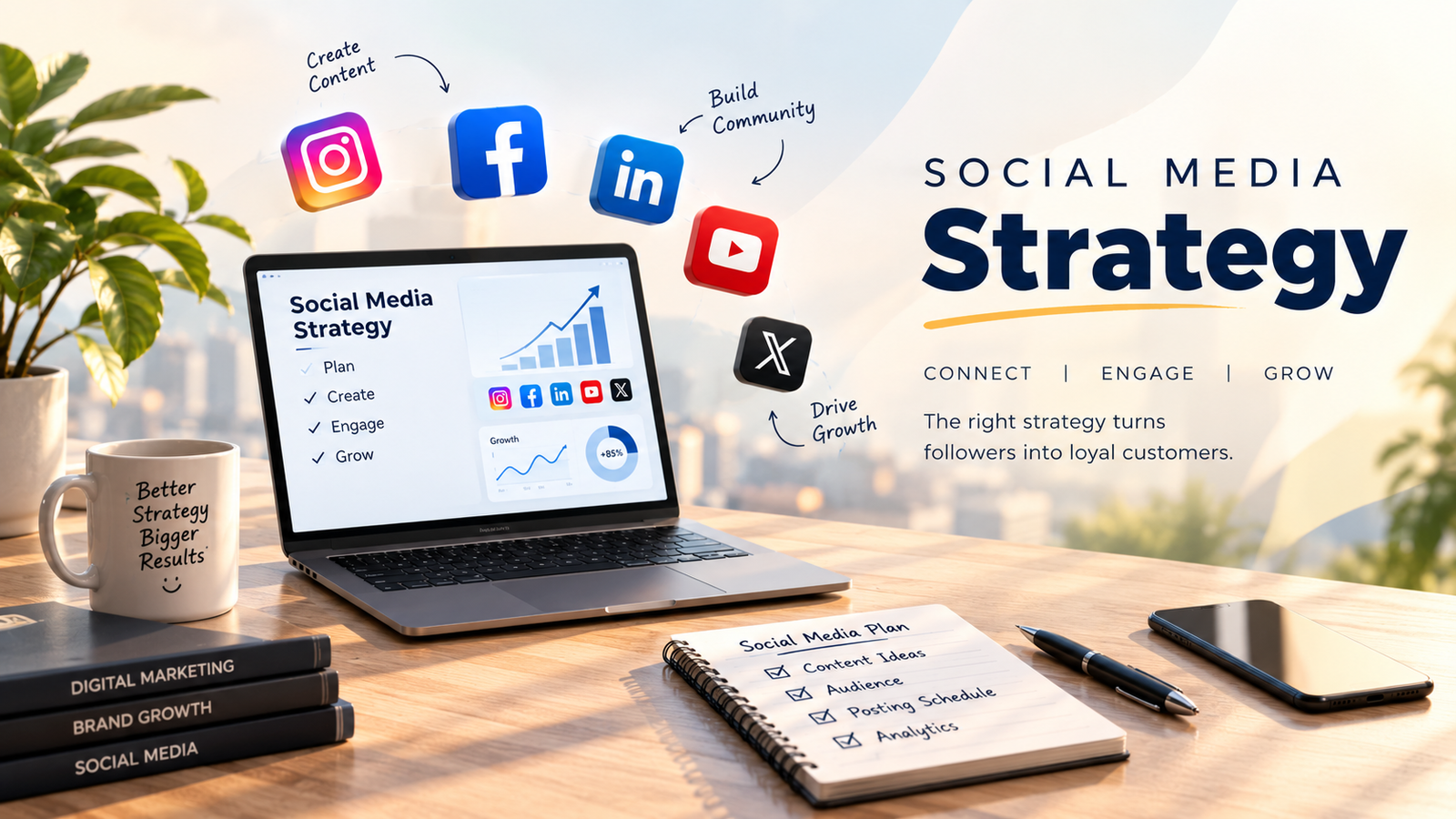
Social Media Strategy: Importance, Benefits, and How to Create an Effective Plan for Your Business
Introduction

In today’s digital world, social media has become one of the most powerful tools for businesses to connect with their target audience, build brand awareness, and increase sales. Platforms such as Instagram, Facebook, LinkedIn, YouTube, and Pinterest allow businesses to communicate directly with potential customers and promote their products or services.
However, simply creating social media accounts and posting content regularly is not enough to achieve meaningful results. Businesses need a well-planned social media strategy that defines their goals, identifies their target audience, and delivers the right content on the right platforms.
A successful social media strategy helps businesses establish a strong online presence, build customer relationships, and achieve long-term marketing objectives. Whether you run a small business, a startup, or an established company, having a clear social media plan can make your digital marketing efforts more effective.
In this blog, we will explore the meaning, importance, benefits, key elements, and steps involved in creating an effective social media strategy.
What Is a Social Media Strategy?
A social media strategy is a structured plan that explains how a business will use social media platforms to achieve its marketing goals. It includes content planning, audience research, platform selection, posting schedules, audience engagement, advertising, and performance measurement.
The primary purpose of a social media strategy is to ensure that every social media activity supports a specific business objective.
For example, a local clothing brand may use Instagram to showcase its products, Facebook to reach local customers, and influencer collaborations to increase brand visibility.
An effective strategy answers five important questions:
- What are your goals? Define what you want to achieve through social media.
- Who is your target audience? Understand the people most likely to purchase your products or services.
- Which platforms should you use? Choose platforms that match your audience and business objectives.
- What content will you publish? Create useful, engaging, and relevant content.
- How will you measure success? Track performance using meaningful metrics.

Why Is Social Media Strategy Important?
Social media marketing has become an essential part of modern digital marketing. A clear strategy helps businesses avoid random posting and focus on activities that deliver measurable value.
1. Builds Brand Awareness
A consistent social media presence helps people discover your business and understand what you offer. Publishing informative posts, short videos, stories, and creative visuals can introduce your brand to a wider audience.
Over time, consistent branding helps customers recognize and remember your business.
2. Reaches the Right Audience
Every business has a specific target audience. A social media strategy helps identify their interests, needs, location, age group, and online behaviour.
This understanding allows businesses to create relevant content and select platforms where potential customers are most active.
3. Improves Customer Engagement
Social media creates opportunities for two-way communication. Customers can comment on posts, ask questions, share feedback, and send direct messages.
Responding to these interactions helps businesses build stronger relationships and understand customer expectations.
4. Supports Business Growth
A well-planned strategy can guide potential customers from discovering a brand to exploring its services and making a purchase. When social media activities are aligned with business goals, they can contribute to enquiries, website traffic, leads, and sales.
5. Strengthens Your Online Presence
Customers often research businesses online before making purchasing decisions. Active and professional social media profiles provide additional information about your services, expertise, customer experience, and brand personality.
This can help establish credibility and make your business easier to discover.
Top Benefits of Social Media Strategy
An effective social media strategy offers several advantages for businesses of all sizes.
1. Cost-Effective Marketing
Creating organic social media content is often more affordable than traditional advertising. Small businesses and freelancers can use educational posts, reels, videos, and community engagement to promote their services without requiring a large marketing budget.
Paid campaigns can also be introduced when a business needs to reach a specific audience or achieve a particular objective.
2. Increased Website Traffic
Social media platforms can direct interested users to your website, service pages, landing pages, and blog posts. Sharing valuable content with relevant links encourages users to explore your business further.
For better results, use clear calls to action, such as “Read Our Latest Blog,” “Explore Our Services,” or “Contact Us Today.”
3. Lead Generation
Social media can help businesses attract potential customers through informative content, lead forms, offers, webinars, and direct messages.
For example, a digital marketing freelancer can share SEO tips, advertising case studies, and social media marketing advice to attract businesses that need marketing support.
4. Better Customer Relationships
Regular communication helps businesses remain connected with existing customers. Answering questions, acknowledging feedback, and sharing helpful information can improve the customer experience and encourage repeat business.
5. Competitive Advantage
Monitoring competitors can help businesses identify content opportunities, industry trends, customer concerns, and gaps in the market.
The goal is not to copy competitors but to learn from the market and develop a distinctive brand voice.
6. Valuable Audience Insights
Social media analytics provide information about how people interact with your content. You can learn which posts attract attention, which videos encourage engagement, and which campaigns generate enquiries.
These insights help you improve future marketing decisions.
7. Improved Brand Authority
Sharing expert advice, practical tutorials, industry updates, and original insights can position a business as a knowledgeable source in its field.
For service-based businesses, demonstrating expertise through helpful content can be particularly valuable when building trust with potential clients.
8. Supports Customer Retention
Social media is useful not only for acquiring customers but also for maintaining relationships with existing ones. Product updates, useful tips, customer appreciation posts, and community discussions can help keep customers connected to your brand.
Key Elements of an Effective Social Media Strategy
A successful social media strategy combines research, planning, creative execution, and performance analysis.
1. Set Clear Marketing Goals
Start by defining what you want to achieve. Your goals should be specific, measurable, realistic, relevant, and time-bound.
Examples include:
- Increasing Instagram reach over the next three months.
- Generating more qualified enquiries through LinkedIn.
- Increasing website visits from social media.
- Improving engagement on educational videos.
- Growing the number of relevant followers.
Choose goals that support your overall business objectives rather than focusing only on follower count.
2. Identify Your Target Audience
Understand who your ideal customers are and what problems they want to solve.
Consider their demographics, interests, challenges, purchasing behaviour, and preferred social media platforms.
For example, a B2B marketing consultant may focus on LinkedIn, while a fashion business may prioritize Instagram and Pinterest. The best platform depends on where the intended audience is active and how it uses that platform.
3. Choose the Right Social Media Platforms
You do not need to be active on every social media platform. Focus on the channels that provide the greatest opportunity to reach your audience.
- Instagram: Reels, visual storytelling, brand awareness, and community building.
- Facebook: Community engagement, local business promotion, and advertising.
- LinkedIn: Professional networking, B2B marketing, and industry expertise.
- YouTube: Tutorials, educational videos, product demonstrations, and long-form content.
- Pinterest: Visual discovery, inspiration, and traffic to relevant websites.
- TikTok: Short-form video discovery and creative content, where available and appropriate for your market.
Select platforms based on your business type, available resources, and marketing goals.
4. Develop a Content Strategy
Content is at the centre of social media marketing. Your content should educate, entertain, inspire, or help your audience solve a problem.
Useful content formats include:
- Educational posts and industry tips.
- Short-form videos and reels.
- Infographics and visual guides.
- Customer testimonials and reviews.
- Behind-the-scenes content.
- Product or service demonstrations.
- Frequently asked questions.
- Offers, announcements, and promotional posts.
A balanced content mix helps maintain audience interest without making every post feel like a sales pitch.
5. Create a Social Media Content Calendar
A content calendar organizes what you will publish, when you will publish it, and which platform you will use.
It makes content production more consistent and helps you plan around product launches, seasonal events, campaigns, and business priorities.
For example, you could publish educational content on Monday, a short video on Wednesday, a customer success story on Friday, and an interactive story over the weekend.
Treat this as a starting point and adjust the schedule according to your audience’s behaviour and available resources.
6. Maintain Consistent Branding
Use a recognizable visual identity across your social media profiles. This includes your logo, colours, typography, writing style, profile information, and overall presentation.
Consistency helps customers recognize your business and understand its personality.
7. Engage With Your Audience
Social media is not only a publishing channel; it is also a communication platform.
Respond to comments and messages, ask relevant questions, encourage discussions, and acknowledge customer feedback. Meaningful engagement helps create a stronger community around your brand.
8. Use Paid Social Media Advertising Strategically
Organic content can build relationships and visibility, while paid advertising can help expand reach and target specific audiences.
Businesses can use paid campaigns to promote services, generate leads, increase website visits, or retarget eligible audiences.
Start with a clear objective and a manageable budget. Monitor results and improve campaigns based on performance rather than spending money without a defined plan.
9. Track and Measure Performance
Regular analysis helps you understand whether your strategy is working.
Important metrics include:
- Reach: Number of unique accounts that saw your content.
- Impressions: Number of times your content was displayed.
- Engagement rate: Interactions relative to a defined audience or exposure measure.
- Click-through rate (CTR): Percentage of impressions or relevant views that result in clicks, depending on the reporting definition.
- Website traffic: Visits coming from social media channels.
- Conversion rate: Percentage of relevant visitors or users who complete a desired action.
- Cost per lead: Advertising expenditure divided by the number of leads generated.
- Return on ad spend (ROAS): Revenue attributed to advertising divided by advertising expenditure.
Choose metrics that match your goals and use platform analytics, website analytics, and advertising reports to evaluate performance.
How to Create a Social Media Strategy Step by Step
Follow this practical process to build a strategy for your business.
Step 1: Audit Your Existing Profiles
Review your current social media accounts, content quality, engagement, audience, profile information, and previous campaign results. Identify what works and what needs improvement.
Step 2: Research Your Audience and Competitors
Study your customers’ needs and review relevant competitors. Look for content gaps, recurring questions, popular formats, and opportunities to communicate your unique value.
Step 3: Define Your Goals and KPIs
Choose clear objectives and identify the key performance indicators (KPIs) you will use to measure progress.
Step 4: Select Platforms and Content Formats
Prioritize the channels your target audience uses and choose formats that suit your resources, message, and objectives.
Step 5: Plan and Publish Content
Create a content calendar, prepare your creative assets, write captions, and publish consistently. Maintain quality rather than posting simply to meet a daily quota.
Step 6: Engage and Build Relationships
Respond to comments, answer questions, and participate in relevant conversations. Make customer communication an ongoing part of your strategy.
Step 7: Analyse and Optimize
Review performance regularly. Repeat successful approaches, improve weaker content, test new formats, and update your plan as your audience and business needs change.
Common Social Media Strategy Mistakes to Avoid
Even businesses with good content can struggle when their strategy lacks direction. Avoid these common mistakes:
- Posting without clear goals: Every major activity should support a marketing objective.
- Ignoring the target audience: Content should address real customer interests and problems.
- Using every platform without a plan: Focus your time and resources where they are most effective.
- Publishing overly promotional content: Provide value instead of constantly asking people to buy.
- Ignoring comments and messages: Unanswered questions can create a poor customer experience.
- Following trends without relevance: Use trends only when they suit your brand and audience.
- Buying fake followers: Artificial growth does not provide meaningful engagement or reliable business opportunities.
- Failing to measure results: Without analysis, it is difficult to understand what deserves more investment.
- Expecting instant results: Building trust, recognition, and a loyal community generally requires consistency and ongoing improvement.
Social Media Strategy for Small Businesses and Freelancers
Small businesses and freelancers do not always need a large budget to build an effective social media presence. The key is to focus on a clearly defined audience, useful content, and consistent communication.
For example, a digital marketing freelancer can use Instagram to share practical marketing tips, LinkedIn to connect with business owners, and YouTube to publish tutorials. Website links can direct interested viewers to service pages, case studies, or contact forms.
A simple approach is to start with one or two suitable platforms, publish high-quality content consistently, track enquiries, and expand only when the process becomes manageable.
Freelancers can also demonstrate their expertise through project examples, process explanations, customer feedback, and educational content. This helps potential clients understand the value of the services being offered.
Future Trends in Social Media Strategy
Social media continues to evolve, making flexibility important for long-term success.
Some developments worth monitoring include:
- Short-form video: Quick, engaging videos remain an important content format across several platforms.
- AI-assisted content creation: AI tools can support brainstorming, drafting, and planning, but human review is essential for accuracy and originality.
- Social search: Users increasingly explore social platforms for recommendations, tutorials, products, and services.
- Creator partnerships: Relevant creators can help businesses reach established communities and demonstrate products authentically.
- Personalized communication: Audience-specific content and relevant responses can improve the customer experience.
- Social commerce: Supported platforms and features can allow customers to discover and purchase products through social experiences.
Businesses should evaluate trends according to their audience, resources, and goals rather than adopting every new feature.
Conclusion
A well-planned social media strategy is an essential part of modern digital marketing. It helps businesses build brand awareness, connect with their target audience, increase website traffic, generate leads, and strengthen customer relationships.
The most effective approach combines clear goals, audience research, suitable platform selection, valuable content, consistent engagement, and regular performance analysis. Success is not simply about publishing more posts or gaining followers; it is about creating meaningful interactions that support business growth.
Whether you are a small business owner, a startup, or a freelancer, investing time in a clear social media strategy can help you make better marketing decisions and build a stronger online presence.
Ready to improve your social media presence? Start by defining your goals, understanding your audience, and creating a practical content plan. With the right strategy and consistent effort, social media can become a valuable channel for building your brand and growing your business.
If you need professional support with social media marketing, content planning, audience engagement, or digital marketing strategy, explore the services available on your website and take the next step toward growing your business online.